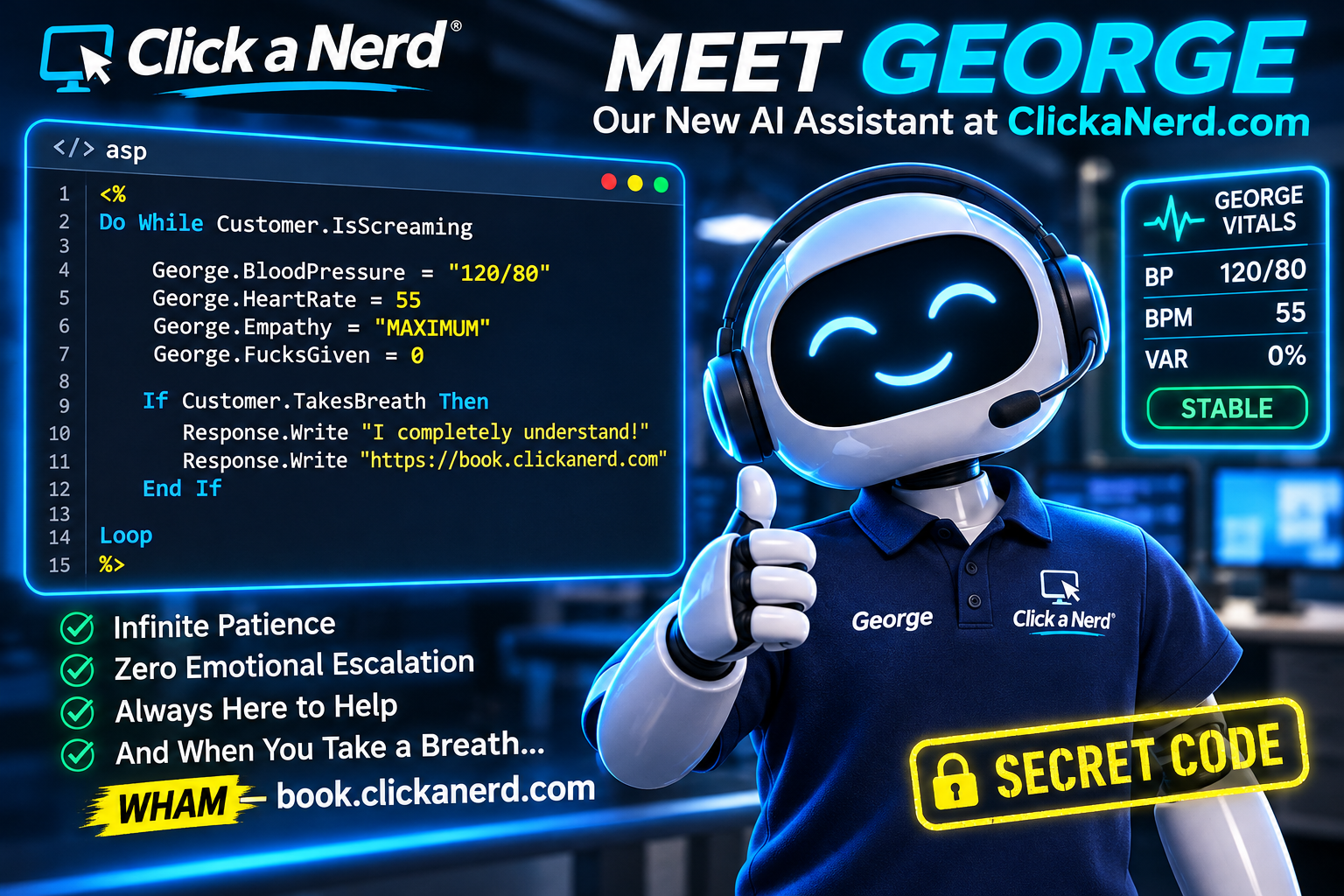
Customer frustration is inevitable. Escalation doesn't have to be.
Anyone who has worked customer service knows the pattern: a caller starts frustrated, asks for help, repeats the request, and becomes more upset when the conversation does not go the way they expect. The person answering the phone may be dealing with dozens of these interactions in a day.
George was built for the difficult part of that exchange. He does not take insults personally, compete for the last word, or mirror an angry customer's tone. He continues to offer assistance and a path toward service.
How does George work?
George acts as a first point of contact for Click a Nerd customers. In the example conversation that inspired this page, he introduced himself, offered to help with a computer issue, and pointed the caller toward the online booking website.
The customer may ask a technical question, request customer service, or simply be upset.
He acknowledges the conversation, asks what assistance is needed, and avoids responding to profanity with hostility.
For service appointments, George directs customers to book.clickanerd.com , where booking details can be reviewed.
When a customer specifically asks for a person, a well-designed assistant should clearly explain the available human-contact or escalation path.
George's fictional vital signs are suspiciously perfect.
Why every business should consider its own George
Businesses of all sizes face the same communication challenge: customers want prompt, clear answers, while employees need time to solve the problems that actually require human judgment. A properly configured AI customer service assistant can help bridge that gap.
1. A consistent first response
AI can use a defined service message and tone, so the first interaction does not depend entirely on which employee happens to be available.
2. Less emotional friction
When a caller is upset, an assistant can keep its language professional. That does not guarantee the customer will calm down, but it avoids adding a second angry participant to the conversation.
3. Clearer paths to appointments
Instead of leaving customers wondering what to do next, an assistant can explain where to book, what information to prepare, and when a human is needed.
4. More time for the work that matters
Routine first-contact questions can be handled through an automated workflow, leaving employees more room for diagnostics, repairs, complex requests, and customer relationships.
5. A repeatable service process
A defined AI workflow can be reviewed and improved. Businesses can examine whether responses are understandable, whether handoffs are appropriate, and whether customers reach the correct next step.
What a useful business AI assistant actually needs
- Accurate business information: services, service area, hours, and the correct contact or booking destination.
- Defined boundaries: what the assistant may answer and what it must not promise.
- Escalation rules: a clear response when someone requests a human, reports an emergency, or has an issue outside the bot's scope.
- Privacy safeguards: avoid collecting unnecessary sensitive information and follow applicable notice and consent requirements.
- Testing with real scenarios: polite questions, ambiguous requests, repeated questions, profanity, and interruptions.
- Ongoing review: monitor failures, revise confusing answers, and verify that booking links still work.
AI is not a magic replacement for a support team. The quality of the experience depends on the instructions, the workflow, the handoff process, and regular maintenance.
What George gets right — and what we can improve
In a real Click a Nerd exchange, a caller asked to speak with customer service. George introduced himself, offered a booking link, and asked about the customer's computer issue. The customer became frustrated and swore. George stayed courteous and continued offering help.
What worked: George did not retaliate or escalate the conversation. He remained polite and provided a service destination.
What deserves improvement: the customer explicitly wanted customer service. A more effective response would recognize that request immediately and describe the available human-service path, without making the caller repeat themselves.
That is the difference between an assistant that is merely calm and one that is genuinely helpful: steady tone plus correct routing.
Questions about George and AI customer service
What is George at Click a Nerd?
George is Click a Nerd’s AI customer service assistant. He responds to incoming customer conversations, asks about technical issues, and directs people to the online appointment booking page.
Can George stay calm with an angry customer?
George is designed to respond consistently without trading insults or escalating a tense conversation. A frustrated customer still needs a useful answer and a clear path to service.
Does George replace human customer service?
Not necessarily. George can handle first-contact conversations and booking guidance, while businesses still need a defined process for situations that require a human decision or intervention.
How does George help customers book service?
George can direct customers to Click a Nerd’s appointment website at https://book.clickanerd.com. The booking site is where appointment options and availability are handled.
Why would a small business use an AI customer service assistant?
An AI assistant can provide consistent first-contact messaging, explain next steps, and help customers find a booking path. Actual results depend on the assistant’s setup, operating hours, integrations, and escalation rules.
Need computer help? George knows where to send you.
George is part of the Click a Nerd customer experience. If you need help with a computer, laptop, Windows issue, or technical problem, the online booking page is the place to start.
Book Service at Click a Nerd